5 Things Rust Cheats Actually Change About Your Wipe
· based on the channel yqzkqrv
Key takeaways
- Rust cheats typically bundle ESP (player, loot and crate tracking), aimbot with smoothing, recoil and spread control, and a visual menu for toggling each module.
- Private cheat builds are sold by subscription and tied to a single license key, unlike free public cheats that are widely fingerprinted by anti-cheat.
- ESP reads server data and draws overlays on the client, which is why it can show players and loot through walls without touching hit registration.
- Aimbot settings such as FOV, smoothness and bone target determine how obvious the assist looks in killcams and spectator replays.
- Facepunch bans Rust accounts in waves, and a banned account loses its skins and server progress along with the game license.
Rust cheats are third-party software add-ons that give a player information or aiming advantages the vanilla client does not allow — most commonly ESP overlays that draw players, loot and crates through walls, aimbot assistance with adjustable smoothing, and recoil or spread control. They are sold as paid subscriptions, delivered as an injectable client or loader, and they violate Facepunch's rules, which is why every session carries a ban risk. The private package shown in the breakdown, the ZALIANT Private Rust Cheat, is a typical example of how these products are packaged and marketed.
What a Rust cheat menu actually contains
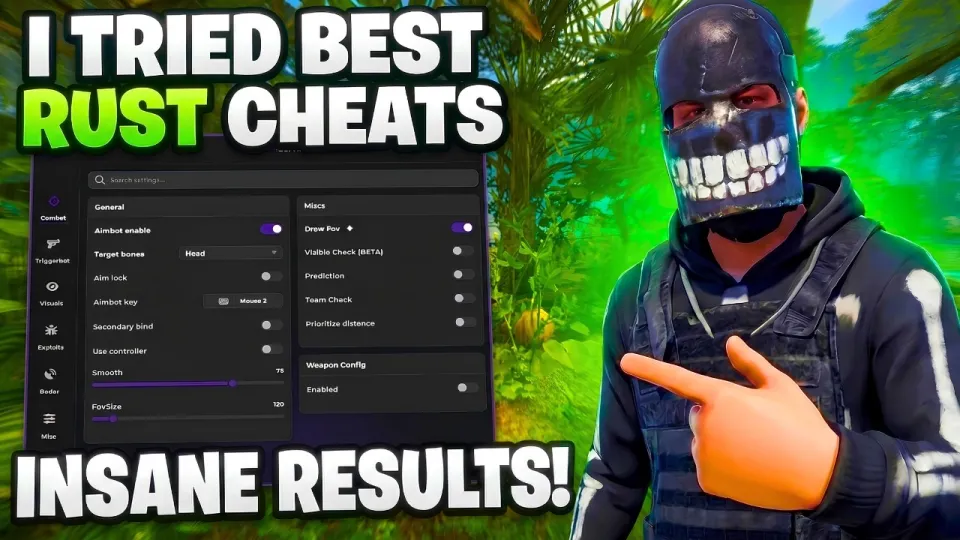
A modern cheat menu is a layered overlay rather than a single switch, and the modules are usually grouped into visual, combat and miscellaneous tabs. The visual tab holds ESP: box or skeleton outlines around players, name and distance tags, health and team indicators, plus filters for loot containers, dropped bags, airdrops, vehicles and sleeping players. The combat tab holds aimbot and silent-aim style functions, with sliders for field of view, smoothing speed, target bone (head, chest, nearest-to-crosshair) and a visibility check so the assist only engages targets you can actually see. The miscellaneous tab typically covers no-recoil, no-spread, instant hit registration tweaks, fast loot pickup and movement modifiers.
Settings matter more than the feature list. A 360-degree aimbot FOV with zero smoothing is functionally a rage cheat and gets noticed within a fight or two; a 3–5 degree FOV with high smoothing and a head-only bone target is what vendors label "legit" configuration. ESP is the same story: drawing every crate on the map is loud, while filtering to player outlines at 150 meters or less is far harder to read from a spectator's perspective.
How private cheat software is sold and delivered
The commercial model for Rust cheats is subscription-based, usually monthly, with the license bound to a hardware ID or a single key. Private builds like the ZALIANT package are positioned as the opposite of free public cheats: fewer users, slower signature turnover, and a loader that requires a key on each launch. Buyers typically get access to a loader download, a key, and a Discord community for status updates and support.
- Purchase a license on the vendor store and receive a key.
- Download the loader from the vendor's delivery page or Discord.
- Disable conflicting overlays and antivirus flags that block the injector.
- Launch Rust, inject, and open the menu with the assigned hotkey.
- Configure modules before joining a server, not mid-fight.
Vendors also sell the promise of updates after each Rust patch. That promise is the whole product: a cheat that is not updated within days of a game update is either broken or detected, and a detected build is worse than no build at all because it converts a working account into a ban.
The real cost of running cheats in Rust
Rust is unusually expensive to cheat in because progress is persistent and tied to the account. A ban removes the game license, every skin in the inventory, and the server history attached to that Steam profile — and Facepunch bans in waves, so a cheat can run clean for weeks before the account disappears. Server owners add a second layer: many community servers run their own anti-cheat plugins, log suspicious statistics such as headshot ratio and pre-fire behavior, and issue local bans that are shared across networks.
There is also a social cost that is specific to Rust. Wipes are long, bases are built over days, and clans remember names. A player flagged as a cheater gets stream-sniped, raided on sight and reported in every Discord that shares the server. The gameplay footage in cheat showcases is always the highlight reel; it never shows the account appeal, the lost inventory or the group that refuses to play with you afterward.
How to judge a Rust cheat showcase before buying
The useful question when watching any cheat video is not "does it look strong" but "what is being shown and what is being hidden". A showcase that only demonstrates the menu and a handful of kills tells you almost nothing about detection status, patch turnaround or support quality. Look for full, uncut fights rather than clipped montages, and check whether the ESP settings shown are realistic or deliberately cranked for the thumbnail.
- Menu walkthrough: does it show every tab and slider, or only the flashiest modules?
- Gameplay context: official servers, community servers, or a private test server with no anti-cheat?
- Update cadence: how quickly did the vendor respond to the last Rust patch?
- Support channel: is there an active Discord with public status posts and ban reports?
- Pricing transparency: monthly only, or lifetime keys that usually signal a resold or leaked build?
The video breakdown by the channel yqzkqrv follows the standard showcase format — intro and menu, feature overview, gameplay, closing review — and uses the ZALIANT private package as its subject. Treat it as a demonstration of the interface, not as proof of undetectability.
Where to find the links from the breakdown
All official links referenced in the showcase point to the vendor's own storefront and community, so there is no ambiguity about where the software is distributed:
- Product page: https://www.zaliantservices.com/products/rustprivate
- Store home: https://www.zaliantservices.com
- Discord community: https://discord.gg/zaliant
Is it worth it
Rust cheats deliver exactly what they advertise — information and aim advantages — and exactly what vendors rarely put in the description: a persistent risk to an account that holds skins, wipe progress and a server reputation. The ZALIANT private build shown in the yqzkqrv breakdown is a well-presented example of the category, with a full menu, configurable ESP and aimbot modules and a subscription model, but presentation is not the same as safety. If you are evaluating the product, start at the ZALIANT Private Rust Cheat page, read the current status and ban reports in the Discord, and weigh the monthly price against the cost of losing the account you are playing on. The video itself is a useful menu tour; it is not a guarantee, and no cheat vendor can honestly offer one.
Source: I Secretly Used Rust Cheat To Dominate Everyone In The Server...(INSANE) · Markdown version
Questions & answers
Are Rust cheats detectable?
Yes. Any client-side cheat has to inject or read memory in a way Facepunch's anti-cheat can look for, and detection is a matter of time and signature updates rather than a permanent state. Private builds with fewer users and frequent updates tend to survive longer than free public cheats, but no vendor can guarantee an account is safe.
What does ESP do in Rust?
ESP draws overlay information the vanilla client hides: player outlines, names, distances, health, and loot or crate locations through walls. It reads data already sent to the client and renders it as a visual layer, which is why it is the most common module in any cheat package.
How much do Rust cheats usually cost?
Most paid Rust cheats are sold as monthly subscriptions tied to a single key or hardware ID, with prices set by the vendor and often tiered by feature set or support level. Lifetime keys exist but are frequently resold or leaked builds that get detected quickly.
What happens if you get banned for cheating in Rust?
Facepunch bans in waves, and a ban removes the game license, the skins in that account's inventory and access to the servers tied to that Steam profile. Many community servers also keep their own ban lists, so a flagged player can lose access to multiple networks at once.